
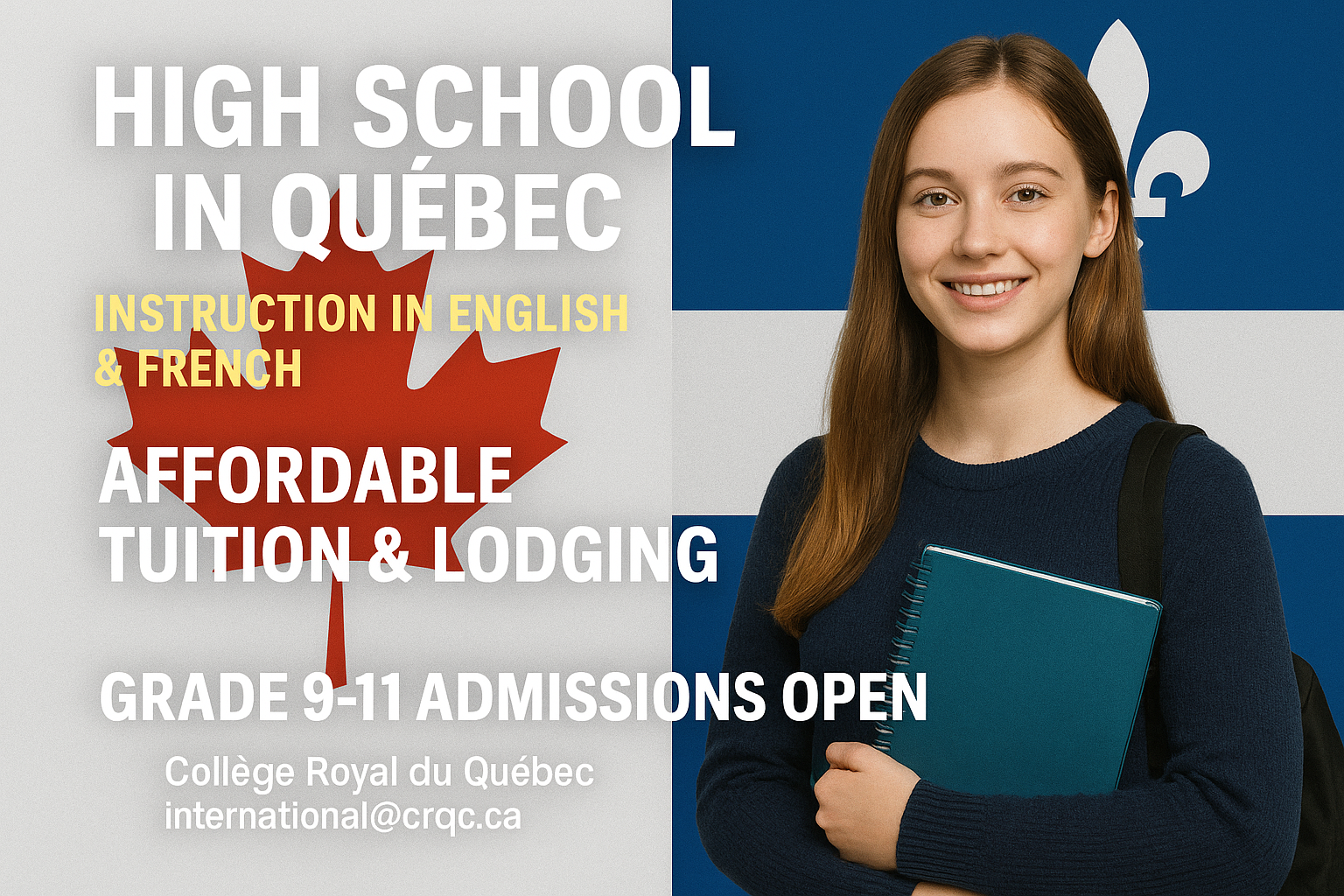
High School in Québec: The Smart, PAL-Exempt Pathway to Canada in 2026
Canada’s new 2026 international student cap has completely changed the game for post-secondary admissions. While many college and university applicants must fight for limited PAL/TAL-required seats, K–12 students have a dedicated, protected stream.
According to IRCC’s 25 November 2025 announcement, Canada plans to issue up to 408,000 study permits in 2026, with
- 115,000 permits reserved for primary and secondary (K–12) students – fully PAL/TAL-exempt
- 49,000 permits for master’s and doctoral students at public institutions – also PAL/TAL-exempt
That means high school in Canada is now one of the most secure and stable ways for families to enter the Canadian system, long before the college/university crunch.
MakeStudy™ and Collège Royal du Québec are leveraging this policy shift to build a low-risk, high-value pathway for Grades 9–11 students who want a long-term future in Canada.
Why K–12 is a Game Changer Under the 2026 Cap
1. PAL/TAL-Exempt = No Competition with Capped Seats
K–12 students do not use up the provincial capped allocation under the new international student cap. Their permits sit in a separate, exempt cohort of 115,000 study permits.
This gives families:
- A more predictable chance of approval
- Less exposure to sudden provincial allocation cuts
- A clean route into Canada that does not depend on limited PAL/TAL slots
2. Earlier Integration, Stronger Outcomes
Starting in Grade 9–11 in Québec allows students to:
- Master English and/or French in a real academic setting
- Build a Canadian transcript before applying to college or university
- Adapt socially and culturally while still young
- Compete as domestic-style applicants later, instead of arriving late into a capped system
3. Direct Pathway to Post-Secondary and University
A Canadian high school diploma from Québec gives students a powerful advantage when applying to:
- Public CEGEPs and colleges
- Universities across Québec and the rest of Canada
- Programs that will increasingly prioritize Canadian-educated students in the capped environment
High School in Québec – Program Highlights
Location & Delivery
- Province: Québec, Canada
- Institution: Collège Royal du Québec
- Levels: Grades 9–11 (Secondary – Second Cycle)
- Languages of instruction: English and French
Academic Experience
- Strong focus on core subjects: mathematics, languages, social sciences, digital literacy
- Options for French-first, English-first or bilingual learning paths
- Support for students coming from English, French or Spanish-speaking backgrounds
Financial & Visa Advantages for Families
No Application Fee + No Registration Fee (Promotional Offer)
For partners and families onboarded through MakeStudy™ campaigns:
- Application fee: waived
- Registration fee: waived
- No hidden admin charges during the admission stage
No Tuition Deposit Before Visa Approval
To keep the process low-risk for families:
- No tuition fee deposit is required to obtain:
- The Letter of Acceptance (LOA)
- The visa support / guardianship support letter
- All tuition fees are paid only after the study permit (visa) is approved
This structure directly addresses concerns in many markets where families fear losing large deposits if a visa is refused.
Guardianship, Safety & Support
High school students need more than just a classroom—they need structure, safety and trusted adults.
- Guardianship support letter provided for visa files
- In many cases, parents are allowed to accompany the student, offering an even stronger sense of security
- Guidance on homestay or supervised lodging options depending on the family’s choice
- Continuous support around well-being, adaptation and academic success
Who Is This Pathway Ideal For?
This high school route is especially powerful for:
- Students aged roughly 14–17 aiming for long-term life and studies in Canada
- Families from French-speaking countries who value Québec’s Francophone environment
- English-speaking students who want to add French bilingual skills for future careers
- Spanish-speaking students seeking a trilingual advantage (Spanish–English–French)
- Agents and schools looking to de-risk Canadian recruitment under the new cap regime
How the Pathway Works – Step-by-Step
Step 1 – Partner & Student Profiling
- Education agents, schools and counsellors connect with MakeStudy™
- We review the student’s age, grade, language background and academic history
Step 2 – Conditional Admission & Fee Waivers
- Student receives conditional admission to high school in Québec
- Application and registration fees are waived under the current promotion
Step 3 – Letter of Acceptance & Visa Support
- After document verification, the school issues:
- Official Letter of Acceptance (LOA)
- Guardianship support letter
- Family prepares the study permit application, benefiting from the K–12 PAL/TAL-exempt status
Step 4 – Pay Tuition Only After Visa Approval
- Once the visa is approved, the family pays the agreed tuition fees
- MakeStudy™ and the school finalize arrival, guardianship and settlement plans
Step 5 – Long-Term Pathway to College/University
- Student progresses through Québec high school
- With a Canadian high school record, they can apply to:
- CEGEPs, colleges and universities in Québec
- Institutions across Canada, including many listed on MakeStudy™ partner networks such as:
- MakeStudy™ Canada Partner Colleges: https://www.makestudy.com/canada/partner-colleges
For Agents & Schools – Why Work With MakeStudy™ on K–12?
- Aligns perfectly with IRCC’s 2026 priorities where K–12 and graduate cohorts are favoured and protected
- Diversifies your portfolio away from heavily capped college/undergrad segments
- Builds longer student lifecycles: high school ? college ? university ? work permits and beyond
- Transparent no-deposit-before-visa policy builds trust with parents
- Central support from MakeStudy™ on applications, documentation and communication
Sample FAQ Section
Is this K–12 high school route affected by the 2026 PAL/TAL cap?
No. IRCC has earmarked 115,000 permits for primary and secondary (K–12) students, and this cohort is exempt from PAL/TAL requirements and does not count against the capped allocation.
Can students study in English only, or is French mandatory?
Families can choose English, French or a bilingual track, depending on the student’s starting level and long-term goals. Québec offers a rich Francophone environment, but pathways exist for both Anglophone and Francophone learners.
Can a parent accompany the student?
In many cases, a parent or legal guardian can accompany the student under appropriate visa categories. MakeStudy™ and the school provide documentation and guidance to support this.
What happens after Grade 11 or 12?
Students can transition into:
- Québec CEGEP or college programs
- Universities in Québec or other provinces
- Other partner schools across Canada supported via MakeStudy™
For Parents & Students
Ready to explore a PAL-exempt, low-risk pathway to Canada’s education system?
- Visit: Our Partner Colleges | MakeStudy
- Email: deepak@makestudy.com | agents@makestudy.com
- WhatsApp / Call: +91 9417895836
For Education Agents & School Counsellors
Become a partner for Canadian high school recruitment in Québec and gain access to:
- Application & registration fee waivers
- No-deposit-before-visa model
- Direct coordination with school and guardianship services
Register or log in as a partner: https://makestudy.com/agents